No SAP yet.
The Brief runs discovery: workshops become cited requirements, contradictions get ruled, the specifications are signed. Forge turns them into tested, evidenced code.
BriefSpecsBuildTrain

Why does billing work this way?
What does ZORD_HOLD actually do today?
What rule is hiding in that 2009 user exit?
If I change this requirement, what code breaks?
How fast can a signed spec become tested code?
Which deliverables have no approval evidence?
What did we believe in March that is no longer true?
What did the last fifty builds teach the next one?
Nexora can. It listens to your workshops, reads your code and runs your program from one record — so every answer arrives with the session, the line and the second it came from.
Read from the room, read from the system, kept for life. Agents produce; humans approve. Every requirement, every line of code and every task traces back to the words someone said.
Workshops in. Cited requirements, ruled contradictions and a signed blueprint out. Aiden answers from it.

Append-only. Every object typed, cited, confirmed by a named person. Nothing crosses customers.
Reads your landscape from the code. Builds from signed specs. Tests with evidence a change board accepts. Trains on every proven build.
Runs the programThe plan and its gates, the delivery plan, the work and who answers for each area. Read straight from the record, so Manage and Governance can never disagree.
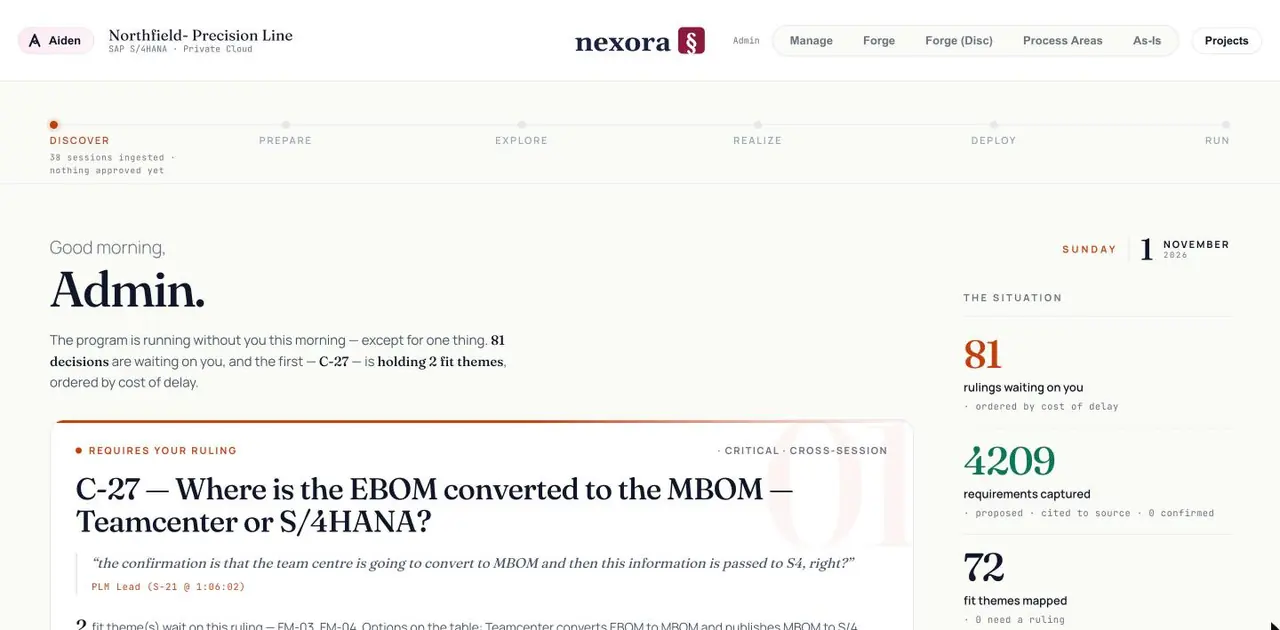
A ruling made in a workshop is the reason a line of code exists, and the reason a task closes. When the three live in one place, nothing has to be reconciled.
Customs asks for origin on every line.Logistics lead, workshop seven.
The Brief runs discovery: workshops become cited requirements, contradictions get ruled, the specifications are signed. Forge turns them into tested, evidenced code.
The acquired business goes through the Brief. Forge reads the parent's landscape, so the fit is decided against what the parent actually runs, not what people recall.
Forge reads the current system, measures every custom object against S/4HANA and rebuilds what has to move. Where the process changes too, the Brief rules first.
Commission work from the Desk: ingest a session, scan a system, assemble the blueprint, modernize a class. Nothing runs by itself.
Specialist agents draft the work — extraction, fit, code, tests. A second agent, on a different model, reviews every draft before you see it.
A named person rules, signs, activates or commits. Only then does a draft cross the Gatekeeper and become memory.
Author, reviewer and approver are always different, and on different models where it matters.
Expert ruling, blueprint sign-off, regeneration commit, comms delivery. Everything else is machine work surfaced for a person.
Aiden answers any question about the program — a ruling, a line of code, an overdue task — and cites the session, the object and the second. Aiden reads the record; it never writes to it.
Service credits were deferred to the parent landscape. The process owner ruled it in session 3 and recorded the two options rejected: building them locally, or dropping them.
Twelve artifacts rest on that ruling — the revenue-recognition design, two test families and the finance change-impact notes. None is on superseded ground.
Nexora runs live on S/4HANA programs today. Three engagements, with every figure drawn from the delivered record.
Acquired entity moving onto the parent's S/4HANA. Nine days from first deliverable set to a board-ready verdict.
The program was re-planned from the customer's own requirements. The estimate narrowed with every ruling.
Undocumented custom code became business facts; the blueprint became clean-core code, traceable line by line.
Only a named person turns a draft into memory.
Author and reviewer run on different models.
A change is a new ruling; the old one stays readable.
The signed blueprint stays retrievable byte for byte.
Approximate times carry a ~. Thin coverage is labelled thin.
A claim its source does not support is marked, never hidden.
Runs inside your own environment.
Original recordings stay in your Drive. Your code stays in your systems; Forge reads it over MCP.
Nothing crosses between customers: not content, not patterns, not statistics. Refused in code, and again by the database.
The memory exports as open JSONL and JSON-LD, readable without Nexora.
Model choice is configuration, never code.
The Brief turns workshops into a cited register, ruled contradictions and a signed blueprint. Forge reads what you run today. Manage sets the plan and the gates.
Forge turns the signed design into code, proves it with evidence a change board accepts, and records the journey as training.
Aiden answers why the system works the way it does, long after the project team has gone. The next project can inherit the memory, within your company only.
One workshop recording is enough. We'll return the record Nexora makes from it — every requirement cited to the second, on your own data, inside your own walls.