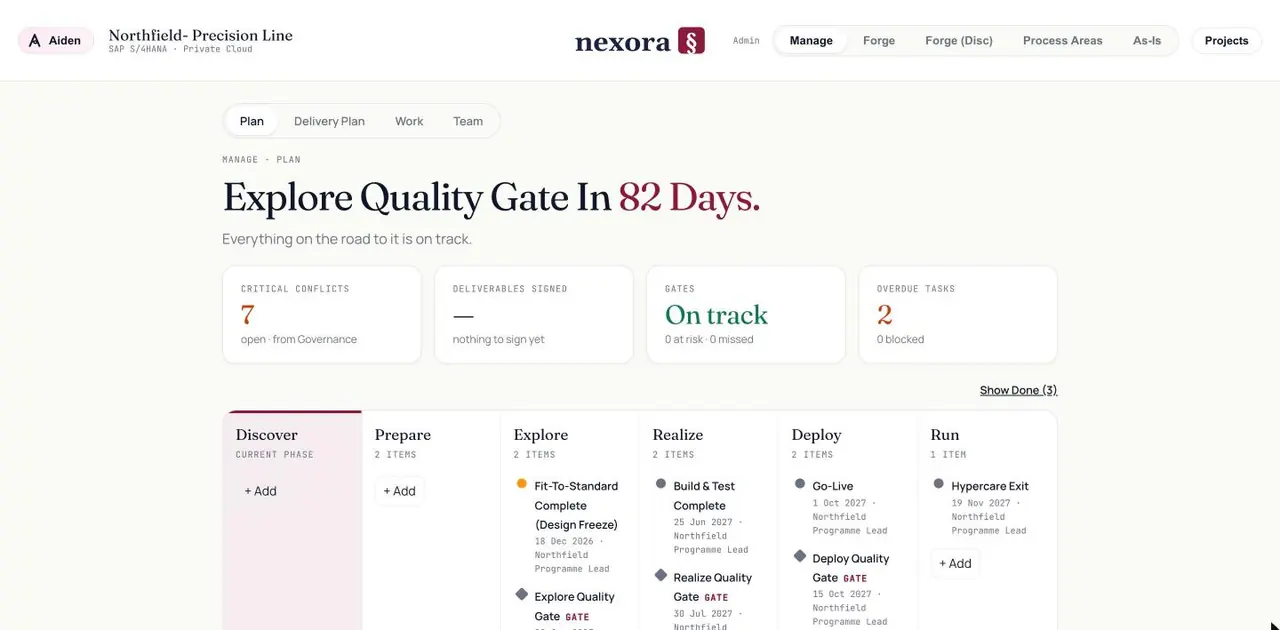
Run the program from the record it is built on.
Manage is the project side of Nexora: the plan and its quality gates, the delivery plan with its people and cost, the work the team owns, and who is accountable for each process area. Nothing here is a second source of truth — critical conflicts and deliverable sign-off are read straight from the record, so what Manage shows and what Governance holds can never disagree.
One platform. Many programs. Nothing shared between them.
Above the single program sits the portfolio: every project you run, grouped by the customer it belongs to, each with its own members, its own Drive and its own record. A project is sovereign — complete on its own, exportable, readable without Nexora. Read-across happens within one customer and never between them.
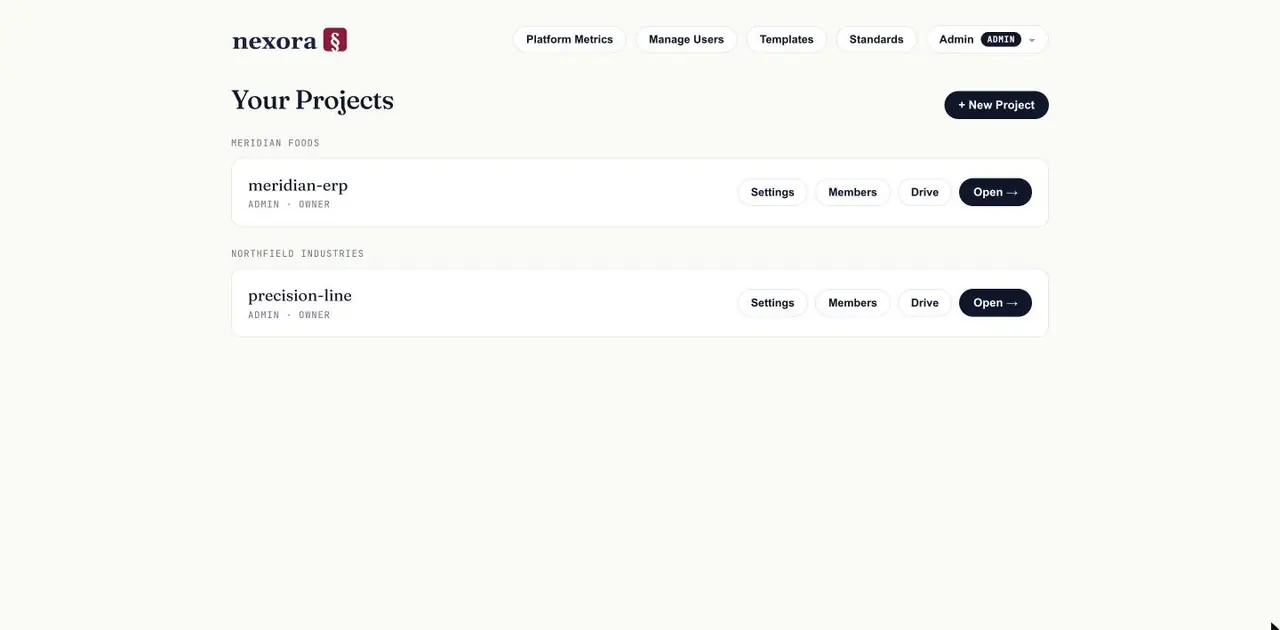
Projects, by customer
Each project declares one origin when it is created — fresh, inherit or consolidate — and that origin is immutable from then on, so no memory arrives without a stated provenance.
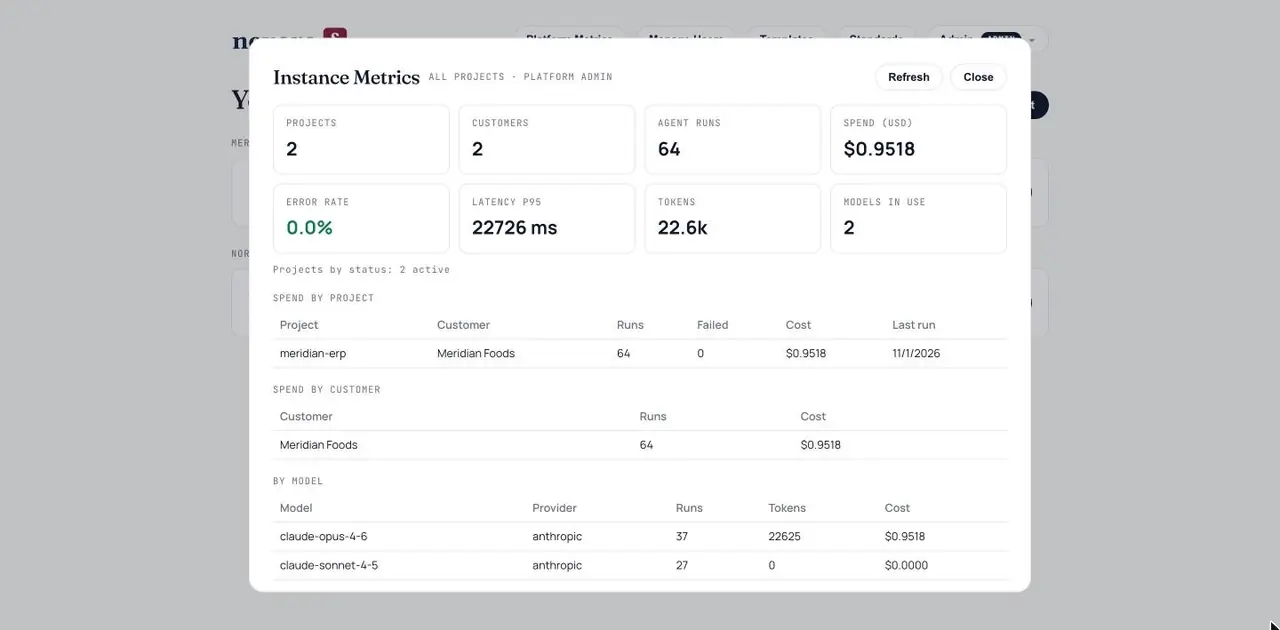
What it ran, and what it cost
Agent runs, failures, latency and spend — per project, per customer and per model. The bill is never a mystery, and neither is which model did the work.
Every area has its judge.
A program is only as decisive as its ownership. Each business domain has exactly one owner — a process expert whose ruling on that area's conflicts is binding — and Nexora will tell you how many of your areas actually have one. Ownership is date-delimited, so a handover is recorded rather than overwritten, and you can read the tenure history long after the person has moved on.
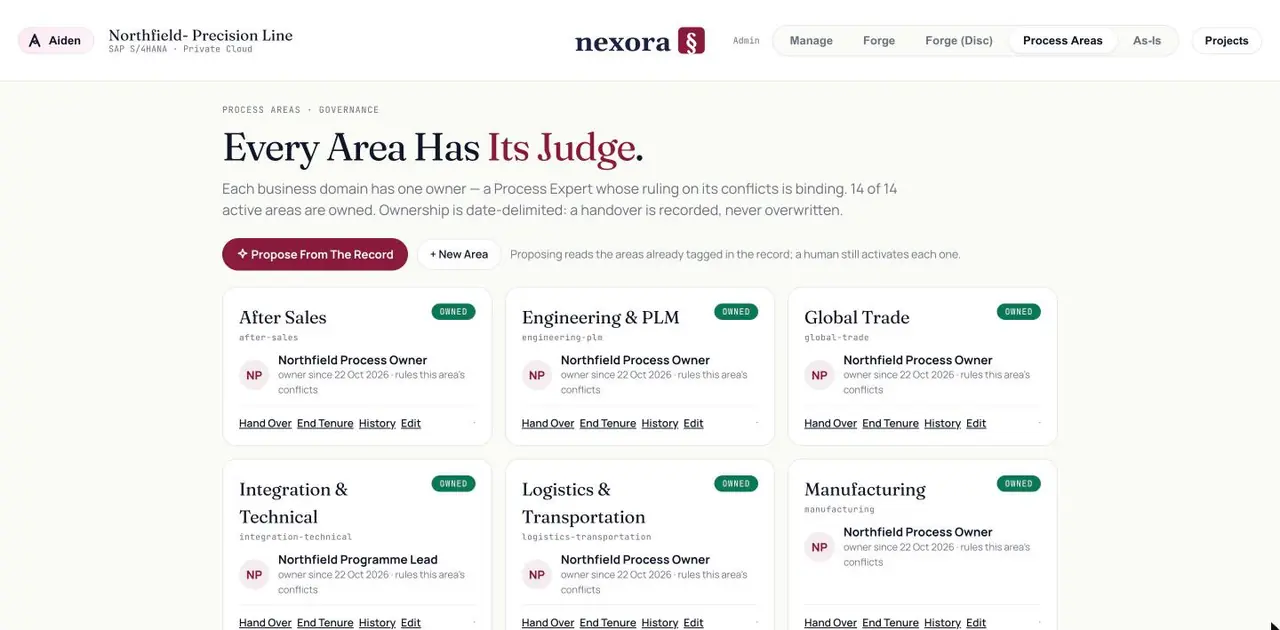
Proposed from the record
Nexora reads the areas already tagged in the record and proposes them; a human still activates each one.
Hand over, don't overwrite
Ending one tenure and starting another is an event in the record, with both sets of dates kept.
Unowned means unrulable
An area with no owner cannot have its conflicts ruled, which is why the count of owned areas is shown up front.
A date is not a plan. The gate is.
Every phase ends in a quality gate, and a gate opens when the record says it can. The countdown is honest because the thing it counts down to is checked against open conflicts and signed deliverables, not against a status someone typed in a meeting.
Phases you can see at once
Discover through Run, each with its milestones, owners and dates. The current phase is marked.
Gates read from Governance
Critical conflicts and deliverable sign-off are never recomputed here — they come from the record.
The plan holds — except the ABAP lead at 120% in Realize.
The delivery plan is one model, not a stack of spreadsheets. Effort, cost, duration and loading all derive from the same resource profiles, so changing an allocation moves every figure together — and an over-allocated person is a headline rather than a cell you had to go looking for.
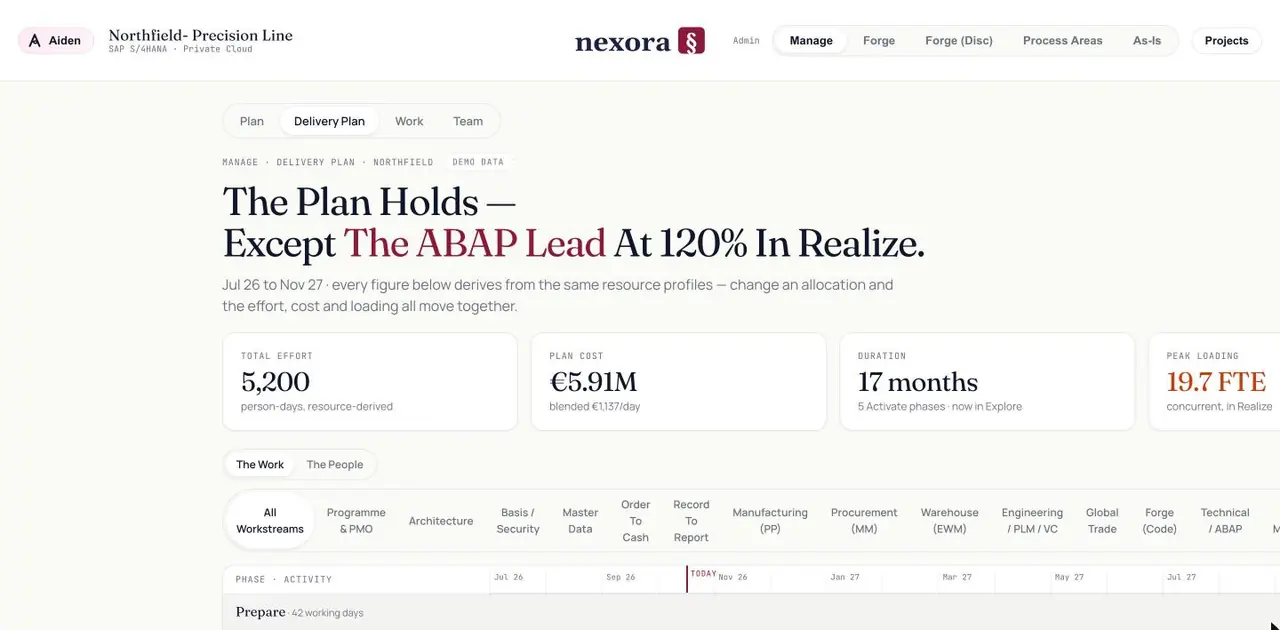
person-days, derived from the resource profiles
months across five SAP Activate phases
concurrent FTE at peak loading, in Realize
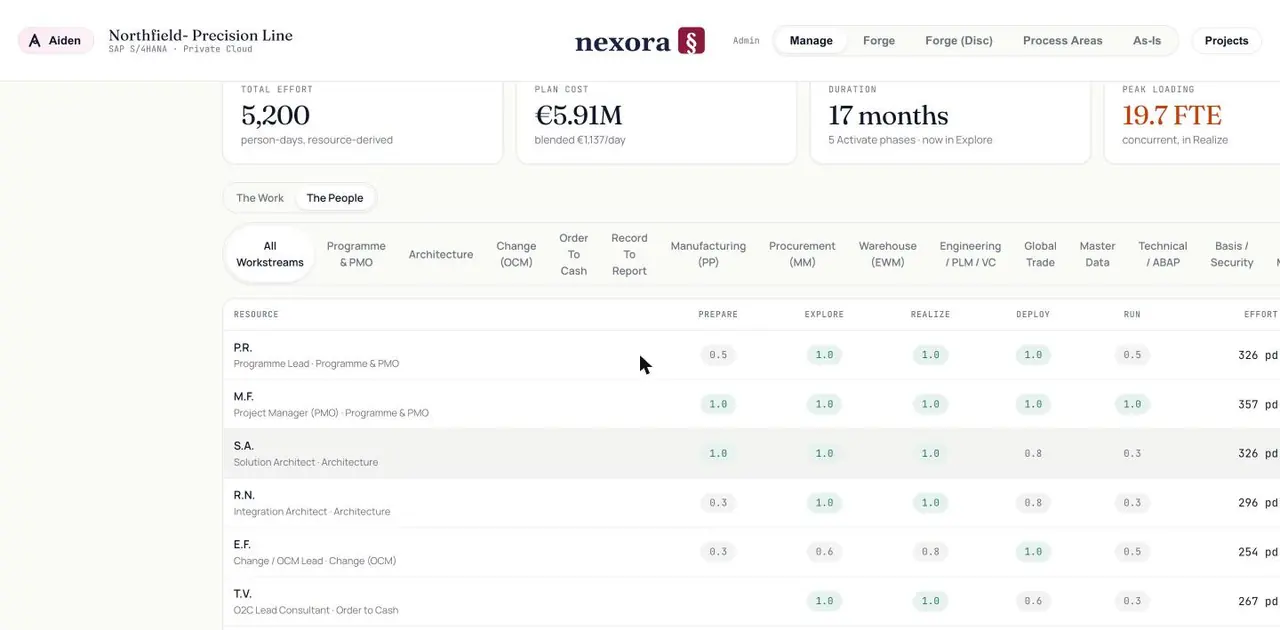
The work and the people, from one model.
Look at the plan by workstream or by person. Allocation is coloured by utilization, effort and cost are derived per row, and Forge (Code) sits in the plan as a workstream like any other — because generated code still has to be reviewed, tested and transported by someone.
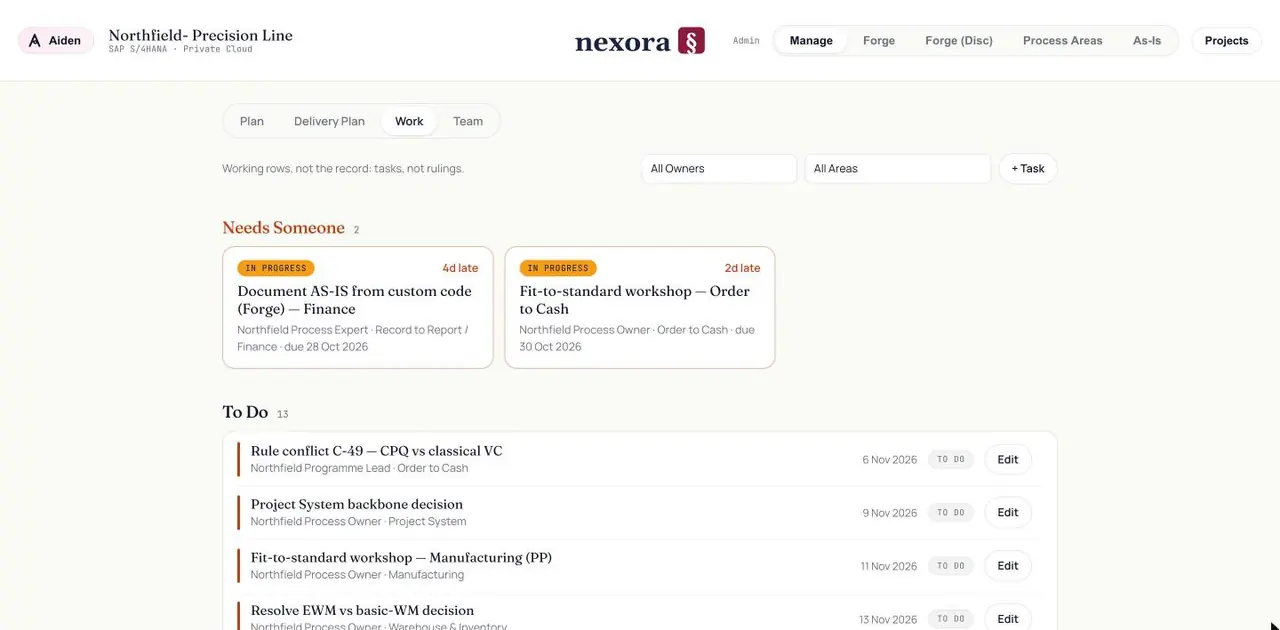
Needs someone, before to-do.
The work list opens with what is stuck and how late it is — not a flat backlog you have to read to the bottom of. These are working rows, not the record: tasks, not rulings. Each one names an owner and a process area, so "who is blocking this" is answered on the page.
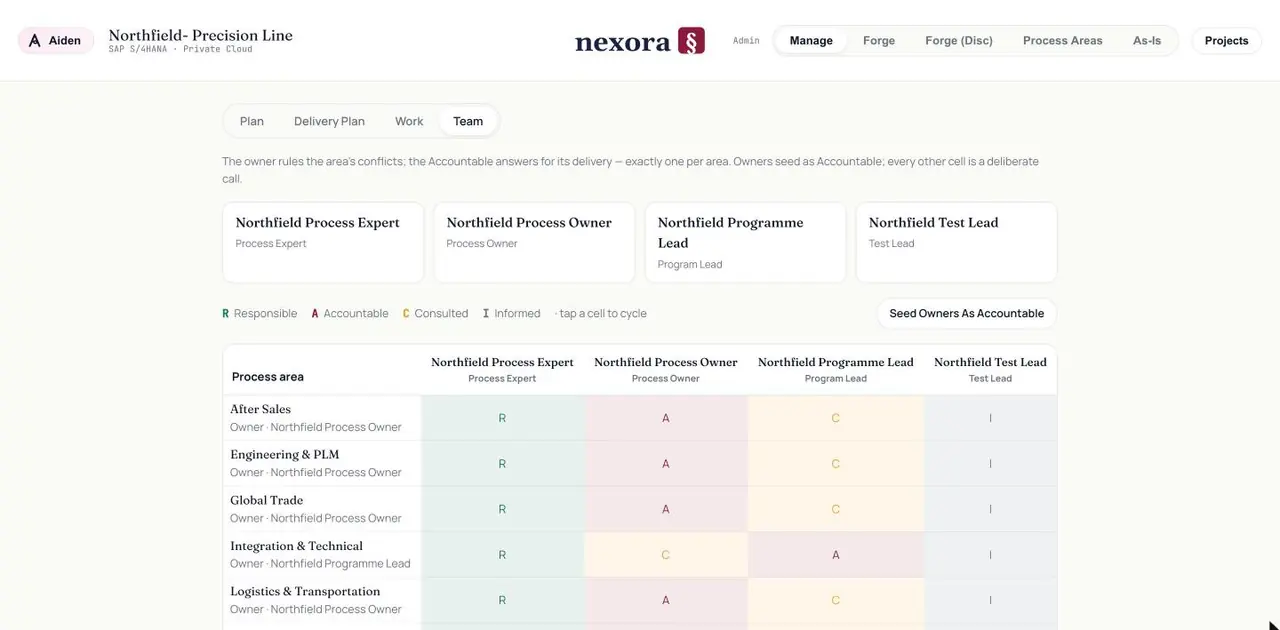
Exactly one person answers for each area.
The owner rules the area's conflicts; the Accountable answers for its delivery — exactly one per area. Owners seed as Accountable and every other cell is a deliberate call, not a default. Ownership is date-delimited, so a handover is recorded rather than overwritten.
An unowned area cannot have its conflicts ruled, which means its gate cannot open. The RACI is not paperwork here; it is what makes the record able to move.